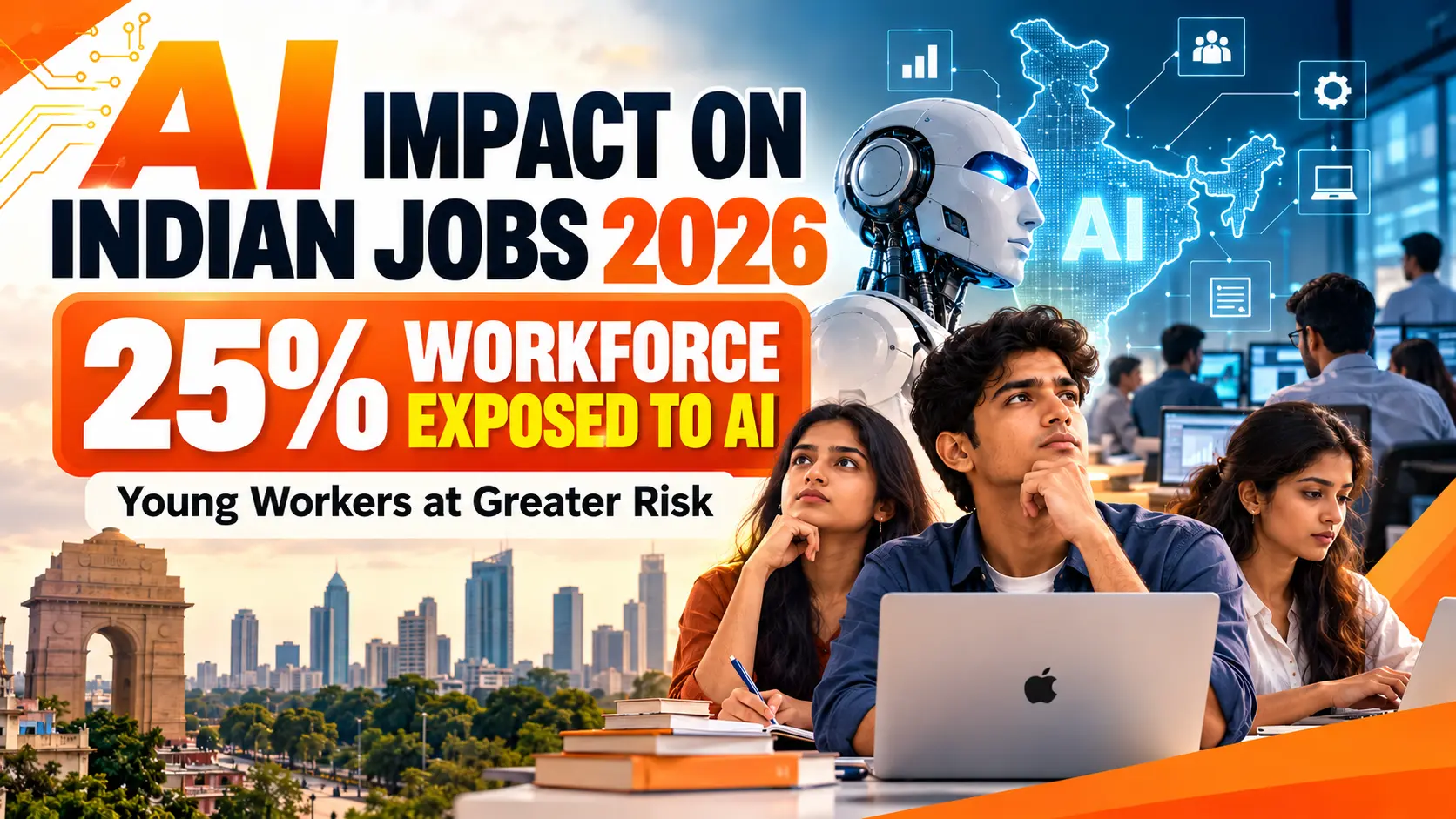
Artificial Intelligence (AI) is transforming India's job market, creating new opportunities while raising concerns about automation and employment. A new study by the Centre for Finance and Economics Research (CFER) at Great Lakes Institute of Management highlights how AI could affect millions of Indian workers, particularly young professionals and employees in routine occupations.
According to the study, approximately 25% of India's workforce is employed in occupations exposed to AI, compared with around 20% in 2012. In urban India, nearly half of jobs are exposed to AI-related changes.
However, AI exposure does not necessarily mean job loss. While some workers could benefit from improved productivity, others may need to develop new skills to adapt to changing workplace requirements.
Key Findings on AI and Indian Jobs
The study highlights several important findings about India's workforce:
- 25% workforce exposure: Approximately one-quarter of Indian workers are employed in occupations exposed to AI.
- Urban employment: Nearly 50% of jobs in urban India are exposed to AI.
- 46 million workers: Around 46 million workers are in occupations where AI could complement human skills and improve productivity.
- 197 million workers: Approximately 197 million workers are employed in highly routine occupations that could face automation risks.
- Young workers: Around 39.4% of workers aged 15–24 are employed in highly routine occupations.
These findings highlight the importance of preparing India's workforce for technological changes.
Will AI Replace Jobs in India?
AI can affect jobs in two major ways. It can automate tasks previously performed by humans, but it can also help employees complete their work more efficiently.
Routine administrative tasks, data processing and repetitive operations may face greater automation pressure. Employees whose work involves predictable, repetitive activities may need to adapt as companies introduce AI-powered tools.
At the same time, professionals who use AI to improve productivity, analyse information and solve problems may benefit from the technology.
Read also: US PERM Green Card Suspension 2026: Impact on IT Jobs
Why Are Young Professionals More Vulnerable?
Young workers entering the job market face particular challenges because entry-level positions often involve routine tasks.
The study found that 39.4% of workers aged 15–24 are employed in highly routine occupations. If companies increasingly use AI to handle these responsibilities, young professionals could have fewer opportunities to gain practical experience and develop workplace skills.
Entry-level jobs help young employees learn communication, problem-solving, decision-making and industry-specific processes.
Employers may therefore need to create new training opportunities to ensure that AI adoption does not reduce learning opportunities for inexperienced workers.
Which Careers Could Offer Future Opportunities?
Careers requiring human interaction, specialised knowledge and practical judgement may offer opportunities in an AI-driven economy.
Some areas to consider include:
- Healthcare and nursing
- Education and teaching
- Elderly care
- Skilled trades and technical services
- Roles involving critical thinking and decision-making
- Jobs requiring client communication and relationship management
These careers are not completely immune to AI. However, many involve responsibilities that require human judgement, practical skills or direct interaction.
How Can Students and Job Seekers Prepare?
Students, freshers and working professionals can take several steps to prepare for changes in the employment market.
- Learn AI tools: Understand how AI can support everyday professional tasks.
- Improve digital skills: Develop practical knowledge of relevant software and technologies.
- Strengthen communication: Build writing, presentation and client-handling skills.
- Develop critical thinking: Learn to evaluate information and verify AI-generated results.
- Gain practical experience: Participate in internships, projects and industry-related training.
- Continue learning: Update professional skills as job requirements evolve.
Employers also need to invest in reskilling programmes and provide young workers with opportunities to learn through practical experience.
Official Source: Great Lakes Institute of Management – Centre for Finance and Economics Research (CFER). Research paper: AI, Automation and India's Workforce: Who Gains, Who's Exposed, and How Policy Can Shape the Future.
What is your reaction?

Subin Babu
Founder, Designer, and Developer of ApplyIn, as well as a Digital Marketing Professional and Content Writer specializing in SEO, AEO, GEO, LLMO, AI-powered search optimization, and performance marketing. With over 3 years of experience in the job portal sector across Kerala and throughout India, specializing in recruitment research, SEO, and content strategy to deliver accurate, trustworthy, and verified information on government and private-sector jobs, examinations, and career opportunities while strengthening online visibility and supporting informed career decisions.
View all articles →